
Collection · Updated
Amazon Public Catalog Data: Proxy Guidance
Amazon marketplaces can vary by domain, delivery location, account state, currency, and personalization. Use Amazon's official APIs, reports, feeds, or licensed providers first. When a permitted public-page workflow needs a regional network sample, Databay residential proxies can vary IP location, but they do not authorize collection or make a request indistinguishable from a shopper.
Pay as you go, no monthly commitment. Order minimums and traffic validity vary by network.
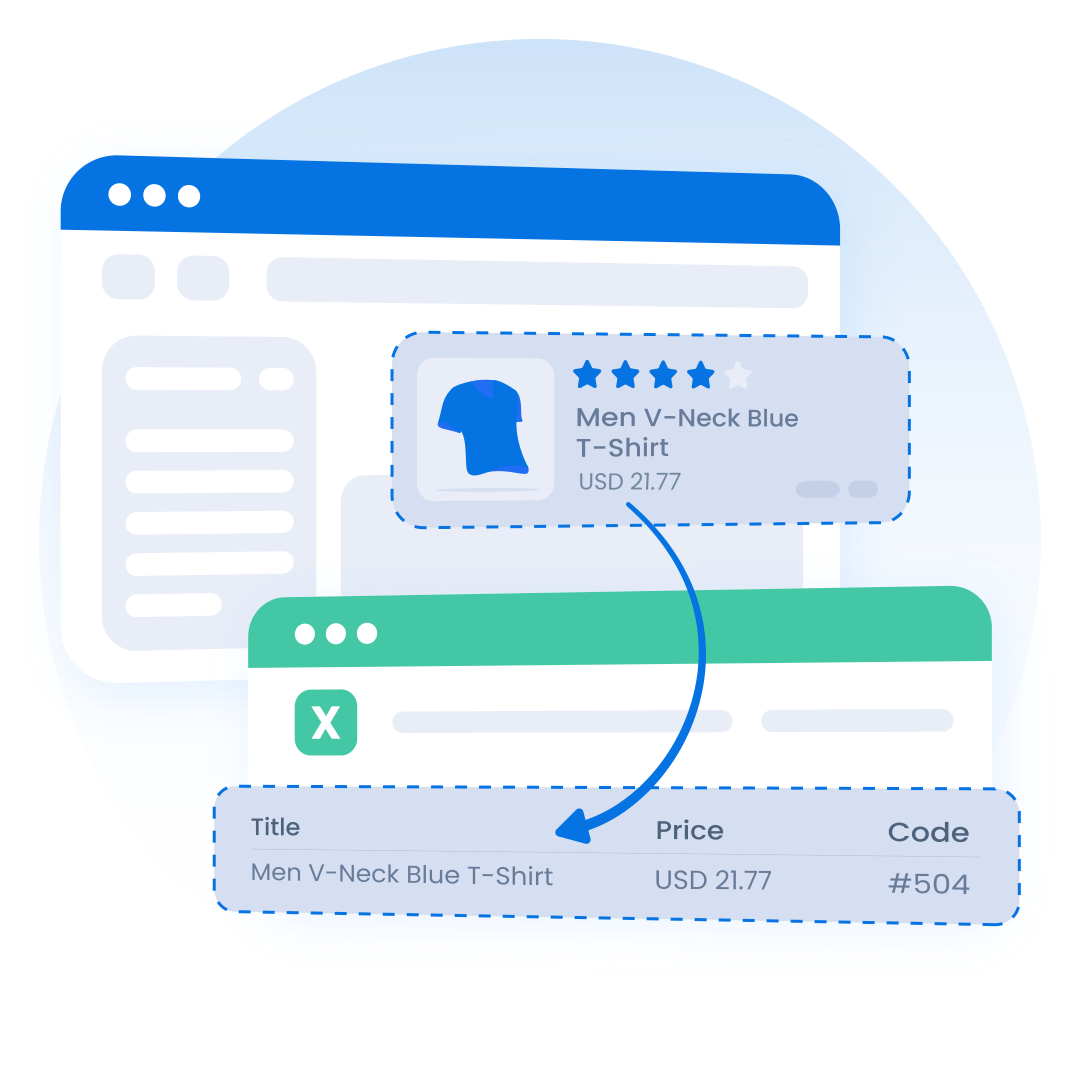
How to run amazon scraping through a proxy route
Collect Amazon public product fields through an ISP-registered exit in the marketplace country.
- InputRegional Amazon marketplace
- RouteResidential session
- OutputProduct record
Client
your code or browser
Databay gateway
gw.databay.co:8888
Residential exit
ISP household address
Target
Regional Amazon marketplace
credentials: USER-countryCode-us:PASSWORD
For amazon scraping: a residential session reaches the regional amazon marketplace, and the product record returns on the same path. The credential string selects the route; the client configuration never changes.
- Regional Amazon marketplace
Start With Official Amazon Data Sources
Seller, vendor, affiliate, and advertising programs expose APIs, reports, and feeds for many commercial use cases. These sources provide documented fields, identifiers, quotas, and permissions, and should be evaluated before collecting pages. If they do not cover the business question, document the gap and obtain approval for any public-page method.
Browser accessibility alone is not permission.
- Buy Box price
Understand What a Regional Proxy Changes
A country-targeted proxy changes the network location Amazon sees. It does not control delivery postcode, marketplace domain, cookies, language, device, Prime status, account history, experiments, or personalization. A regional result is therefore one reproducible observation, not the price or assortment seen by every shopper in that country.
Store all relevant test conditions with the result.
- Stock indicator
Collect Public Pages Conservatively
If counsel and the applicable rules permit public-page collection, identify the smallest set of fields and pages needed, use low concurrency, cache unchanged responses, back off on errors, and stop on access challenges. Do not bypass login, membership, purchase, CAPTCHA, or other technical controls.
Rotation is a capacity and regional-sampling feature; it must not be used to defeat a site's rate limit or block.
- Seller identity
Design for Catalog Variability
Use stable product identifiers where available, parse defensively, and distinguish displayed price, delivery cost, coupon, seller, fulfillment, stock, and observation time. Reconcile edits and removals instead of silently carrying old values forward. Validate a small sample manually in each marketplace and publish missing-data and freshness metrics with downstream reports.
- Buy Box price
Preserve Evidence and Secure the Collector
Normalize product identifiers, seller identity, offer condition, quantity, currency, tax treatment, shipping, coupons, subscriptions, variants, and timestamps. Quarantine partial pages and challenge responses instead of parsing them as catalog data. Store the source URL, retrieval time, response hash, parser version, apparent market, and validation state with each observation, then reconcile material anomalies manually before publishing or acting on them.
Keep credentials in a secret manager, restrict outbound destinations, validate TLS certificates, redact logs, and apply least-privilege access to stored data. If a permitted workflow requires a proxy, compare measured location fulfillment, latency, usable responses, sourcing and consent, security, retention, support, and current cost; no network class guarantees an Amazon response.
- Product record
Legal and Data-Quality Boundaries
Automated access can raise contract, computer-access, copyright, database-right, privacy, and consumer-protection questions that depend on facts and jurisdiction. Van Buren and hiQ do not create a blanket right to scrape, and internal analysis does not automatically eliminate copyright or privacy risk. Keep account-gated data out of scope, minimize personal data from reviews, honor retention limits, and obtain qualified advice for the specific program. This is general information, not legal advice.
Match the IP class to amazon scraping
One gateway connects 34M+ residential, 80K+ datacenter, and 800K+ mobile IPs. Choose the class per target instead of forcing every job through the same pool.
- Recommended
Residential proxies
34M+ ISP IPs200+ countries
Protected targets and precise local views for amazon scraping.
From $0.90/GBat 1 TBExplore Datacenter proxies
80K+ high-speed IPsKey markets
High-throughput work where the target accepts hosting-network traffic for amazon scraping.
From $0.50/GBat 1 TBExploreMobile proxies
800K+ 4G/5G IPs155+ countries
Mobile-first and account-authorised workflows for amazon scraping.
From $2.50/GBat 512 GBExplore
Amazon Scraping FAQ
Why consider proxies for Amazon catalog measurement?
Do residential proxies make requests look like ordinary shoppers?
Can I collect prices from multiple Amazon marketplaces?
How should I respond to CAPTCHA or blocking?
Can I collect public review data?
Is scraping Amazon public pages legal?
How often should Amazon product data be collected?
Build the route for amazon scraping
Start with the target and the vantage point you need, then pick the network class that fits the work. One account reaches all three.
Pricing, order minimums, and traffic validity vary by network.