




Original, reproducible proxy & IP data
We run the measurements, publish the methodology, and name the tools and versions. Cite the result, then re-run the pipeline yourself.
Latest series update August 2026.
- 01Free proxies benchmarked2,911
- 02Residential IPs sampled1,000
What the data shows
Four headline results from the studies below. Each links to the full method, sample and raw numbers.
- 63.9%
of Databay’s free-list proxies were alive, vs 36.7% for the next best of 7 providers, with most lists 80–98% dead.
Read the study - 80.3%
of 1,000 sampled residential IPs hit Spamhaus ZEN, but as PBL “residential” designations, not malicious flags.
Read the study - 0%
CreepJS detection across all three categories for camoufox, the only clean result of 9 automation setups tested.
Read the study - JA3 = client
the HTTP client, not the proxy, determines your TLS fingerprint: identical hashes through residential, mobile and datacenter gateways.
Read the study
Every study, newest first
7 first-party studies. Each names its tools, pins its versions, and shows its work.
Comcast Residential Proxy: AS7922 Evidence and Test Plan
Evaluate a Comcast residential proxy with Databay's published AS7922 sample, live-supply limits, route verification, and a provider-neutral...
Eswatini Proxies: Availability, Setup, and Buyer Checks
Need Eswatini proxies? See which Databay network mappings include country code SZ, what remains unverified, and how to confirm live supply before...
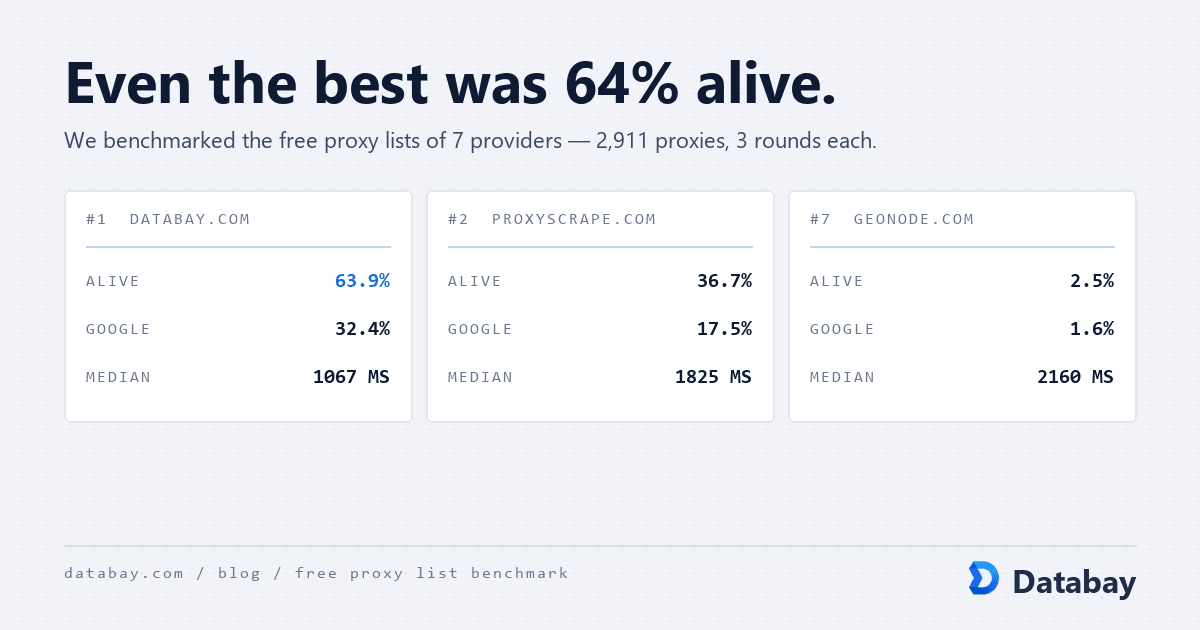
Free Proxy List Benchmark: 2,911 Proxies Tested
Results from a June 11, 2026 test of 2,911 entries across seven free proxy lists, covering availability, HTTPS, latency, stability, and study limits.
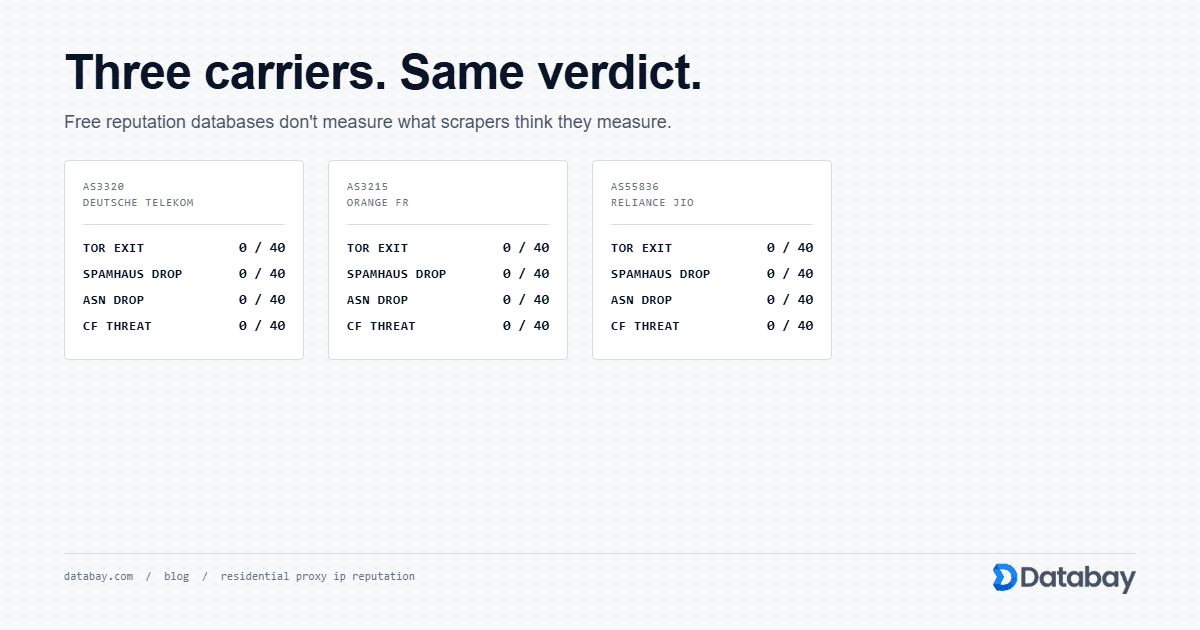
Residential IP Reputation: 1,000 Published Observations
What 1,000 redacted route observations across 25 ASNs show about DNSBL labels, Tor and DROP checks, network classification, and dataset limits.
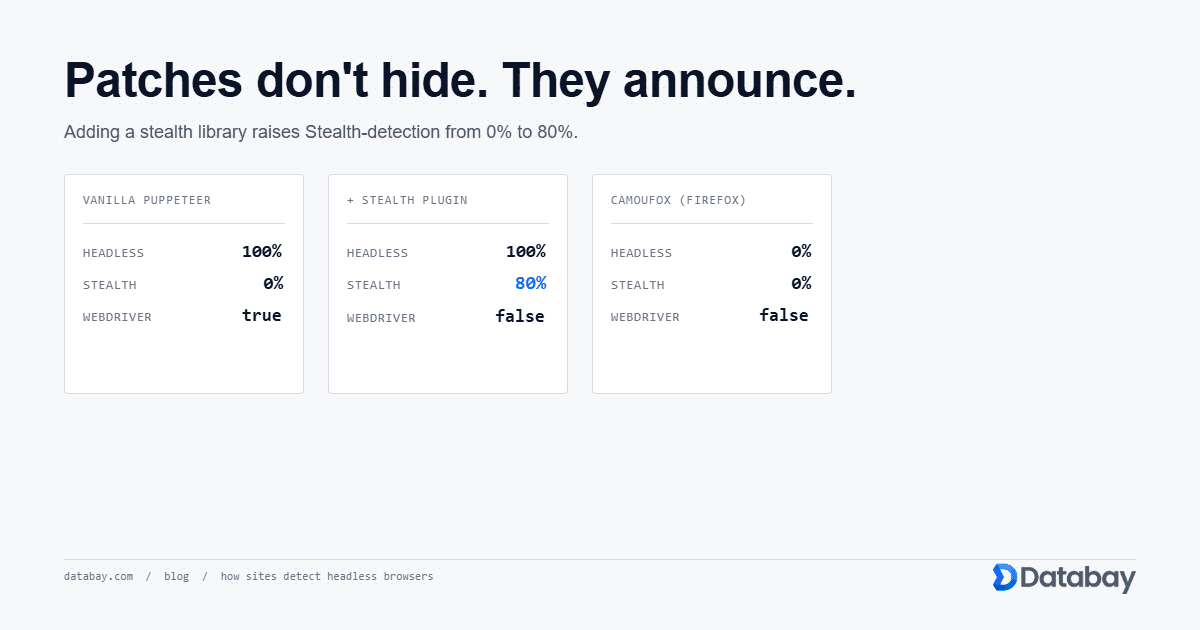
Headless Browser Detection Signals: Defensive Testing
How sites combine browser, rendering, network, session, and behavior signals, and how to test them defensively without treating a fingerprint as...
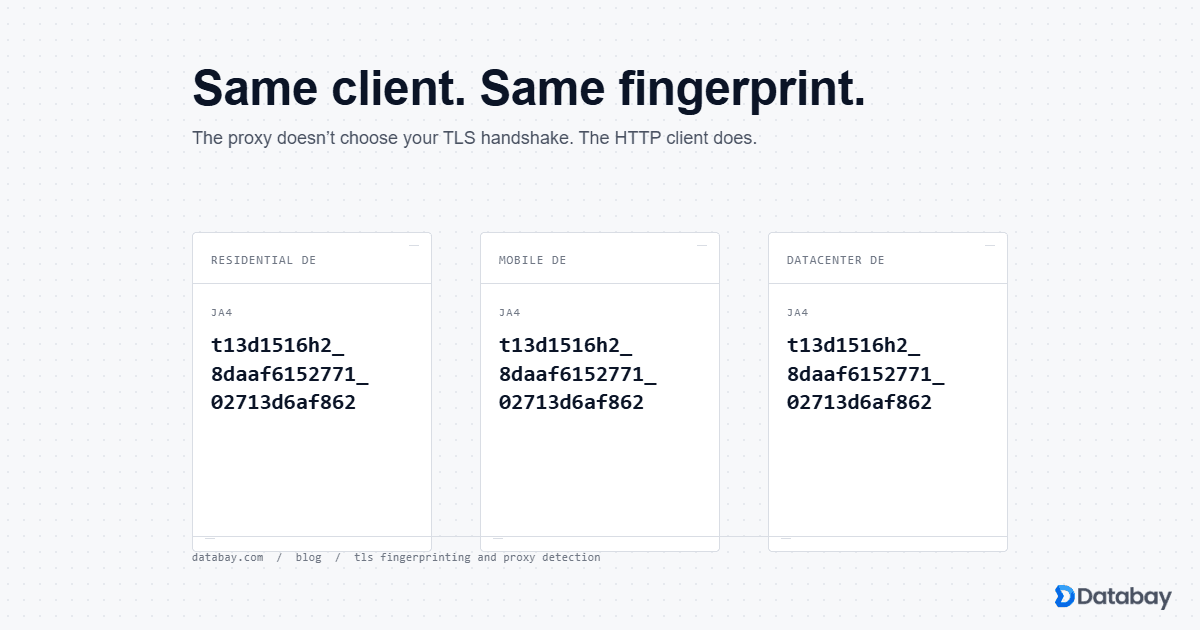
TLS Fingerprinting Through Proxies: JA3, JA4, Tunnels
How JA3 and JA4 summarize TLS clients, when proxies preserve or replace a ClientHello, and how to test a path without treating a hash as identity.
Free Proxy List Methodology and Coverage Limits
Definitions for the fields Databay publishes, the freshness and filtering rules in the website code, and limits on what those observations can prove.
How we run every study
One protocol governs every benchmark, leaderboard and detection matrix we publish. Read it before you cite a number.
- First-party probes, run on Databay infrastructure.
- Every provider probed three times, one frozen snapshot.
- Tool names and versions pinned in each study.
- Method published before any result is.
- 01 / MEASURE
First-party measurement
We run every probe ourselves on Databay infrastructure: no vendor-supplied numbers, no aggregated third-party claims.
- 02 / FREEZE
Frozen snapshots
Every competitor is probed the same way at the same time, three times over, against a pinned snapshot of the field.
- 03 / DISCLOSE
Open methodology
Sources, probe design, thresholds and every column definition are documented before results publish.
- 04 / RE-RUN
Reproducible pipeline
Tools are named and versions pinned in every write-up, so you can re-run the pipeline and check our numbers.
Every study runs on the production network
The residential, mobile and datacenter pools behind these studies are the same ones customers run on. Nothing here was measured on a lab rig.
Put this research to work
The infrastructure and measurement pipeline behind these studies powers Databay's proxy network. Start with the product the data points to.
Review the study methods, limitations, and underlying data before using a finding.